Innate Self-Medication
Book Dispatch Update
We are delighted to let you know that dispatch has now begun, with the first copies left us on Friday 26th June.
Thank you for your patience. Caroline has over 200 books to personally sign and we have more than 400 orders to process.
To ensure fairness, all orders will be dispatched in the order they were received. We truly appreciate your understanding and support, and we look forward to your book reaching you very soon.
Latest reviews
​Dear Caroline, ​I wanted to thank you for my beautiful book - the labours of your love (it shines through). I was so excited when it arrived yesterday. I felt like a child and Christmas had arrived! ​The first thing I did, was sit in the garden in the middle of our 'herby' lawn and read to my dog Homer. We both love it. It seems too simple to call it a 'book' - I can feel all the many lives you've walked through while I'm reading it and so many of your experiences. Its extraordinary. Shelly Mosco
Simply love it! Hi, Caroline, I just wanted to congratulate you on a most impressive publication, well worth waiting for! It is clear to see the extensive research, time, effort, collaboration, heart and soul which went in to creating this masterpiece. I'm sure this highly science and evidence-based authoritative compendium will form a lasting legacy to your many decades dedicated to this work, building on your previous publications as observations and experience has evolved.
It's beautifully structured, clear, concise, engaging and highly articulate, making it a publication which will be highly regarded by academics, IMIM practitioners, scholars and students alike. It has a high quality visual and production appeal too: it is a joy to hold and read! I was particularly pleased to see the references to your human studies.
About 4 weeks ago while I was away, I had what I thought were infected gnat bites. The only essential oil I had with me was a 12ml bottle of German chamomile, and I was immediately attracted to it for its anti-inflammatory and pain-relieving qualities and applied it topically. It was subsequently remotely diagnosed via a photo to my GP many miles away, that it was in fact, shingles. How lucky was I that the one and only essential oil I had with me was German chamomile, which I applied in copious amounts topically. Had I only a 5ml bottle with me, I would have run out! I knew GC was fortunately the right remedy as I remembered that German chamomile was useful in the treatment of the virus, which causes chicken pox. So it was very gratifying to see references to shingles in your new book, and now, if it rears its head again, I will be better prepared! Julia Cardy
Morning Caroline, I just have to tell you how much I am loving your book!! I'm only at page 39 as I like to savour and absorb rather than rush and I'm trying my best not to jump straight to the case studies🤪 but from the beginning your writing pulled me in completely. Your journey, your storytelling, the way you bring us into your world... it is simply incredible. Thank you for pouring so much of yourself into this book. I can already tell it's going to be one I return to again and again. Raoudha Mairos
What began as updating Animal Self-Medication evolved into something far bigger. After several years of research, updating, expanding, rewriting and refinement.
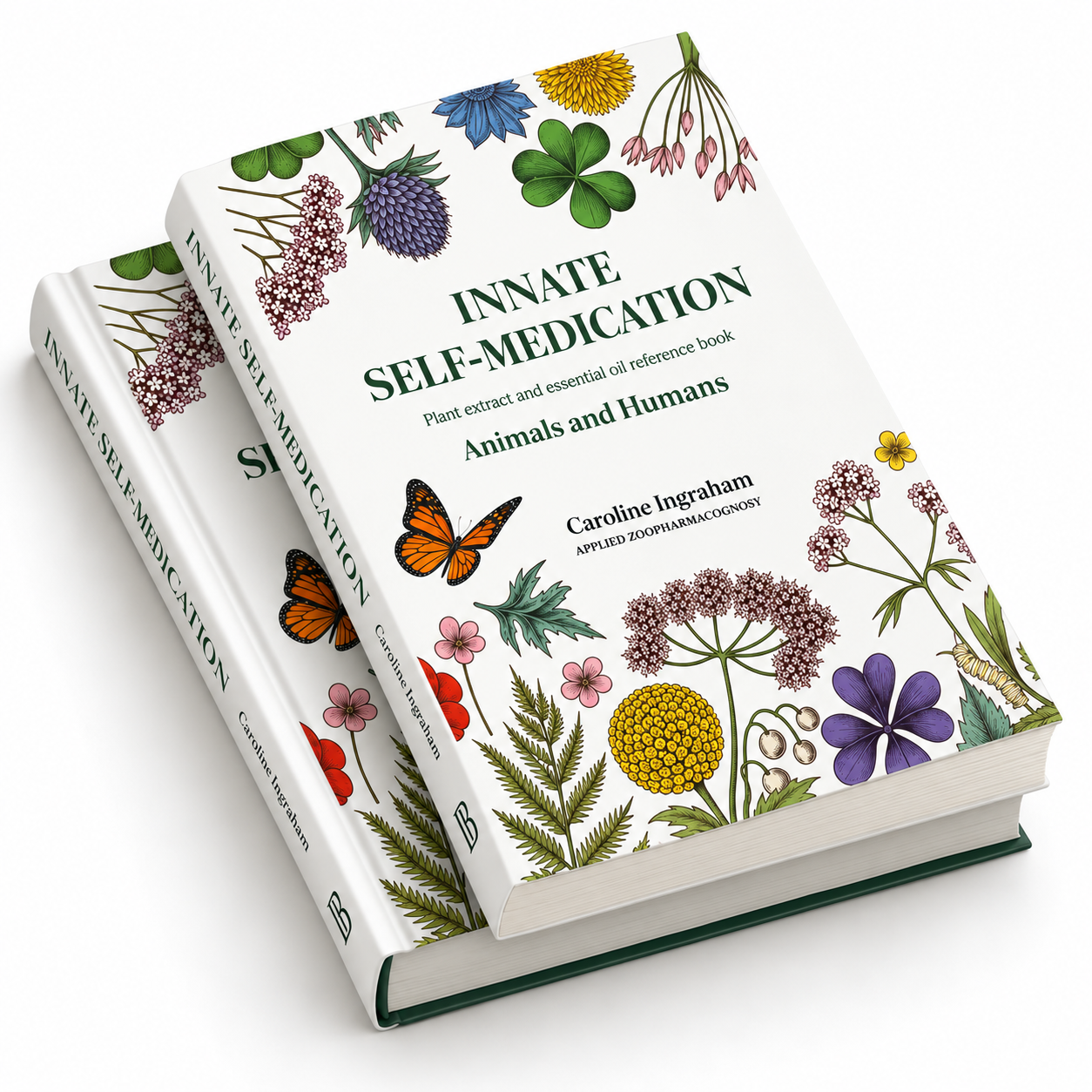
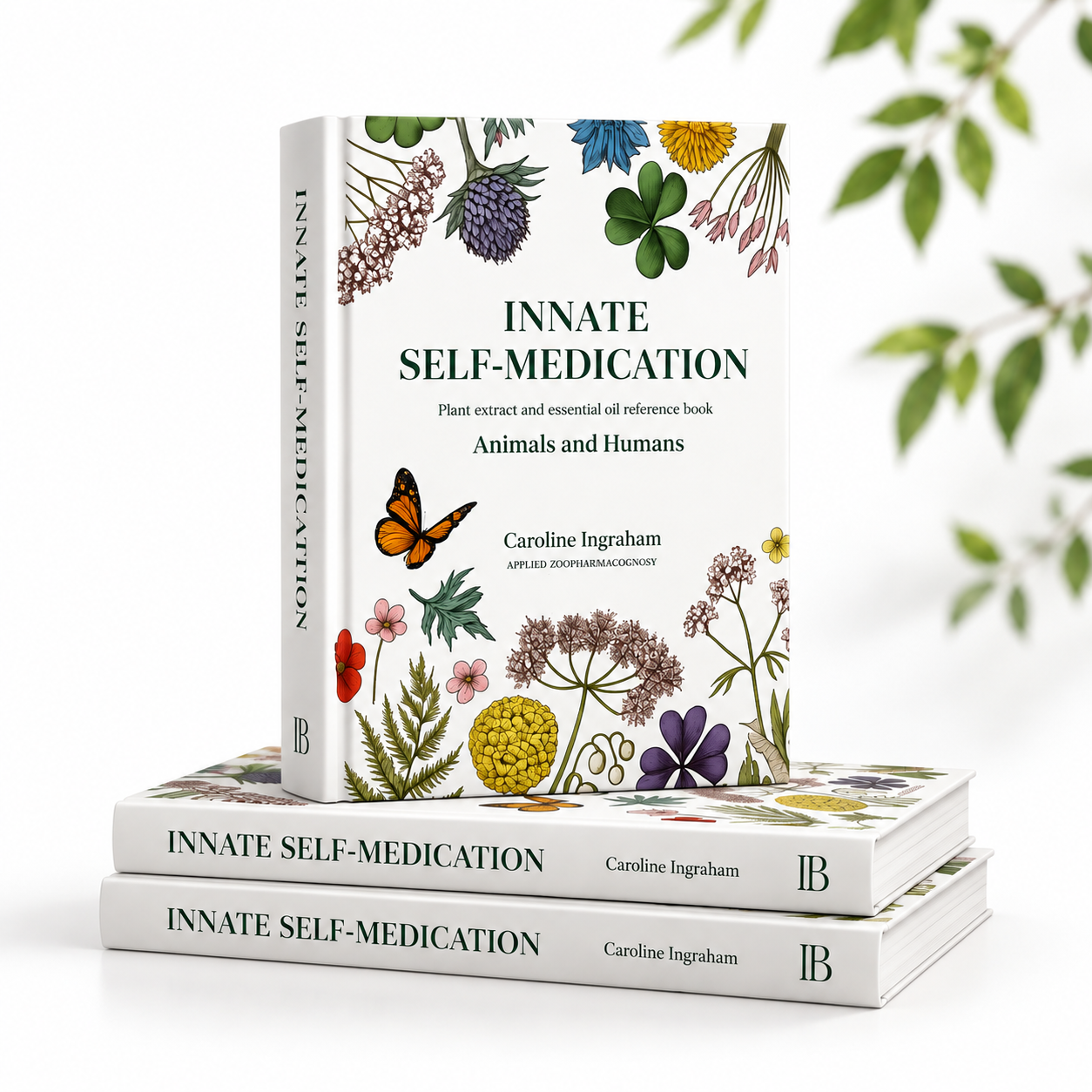
Innate Self-Medication is a substantially expanded work, drawing on cross-species case observations and emerging scientific understanding. It extends and deepens the foundations introduced in Animal Self-Medication, offering a broader exploration of essential oils and other plant extracts.
Representing over 40 years of work
More than 400 copies reserved before publication
Current pre-publication offer ends 1st July
Dimensions: 27.94cm (H) x 21.59 (W): 464 pages
This reference book explores the biological intelligence that underpins self-medication. It challenges assumptions and shows what becomes possible when animals are allowed to participate in their own recovery.
Paperback or Hardback version available.
You will receive email confirmation and tracking once your order is dispatched. Shipping to UK and worldwide.
About The book
Describes how animals and humans instinctively select plant compounds, nutrients, and minerals to restore balance via sensory intelligence.
Challenges clinical models, highlighting why standardised trials miss the individualised nature of self-medication.
Draws on decades of cross-species observation linking remedy choice to symptoms and emotional states.
Introduces self-medication mapping as a framework for analysing selection without removing agency.
Explores smell and taste as mechanisms for real-time regulation of dose and remedy.
Presents a concise Materia Medica integrating traditional use, science, and behavioural observation.
Outlines key biochemical mechanisms, including microbial modulation and neurophysiological effects.
Reframes animals as active agents in their own health and welfare.
In Innate Self-Medication: Caroline Ingraham challenges conventional thinking about health, revealing that the ability to heal is not something we acquire - it is innate.
Drawing on decades of observational work with animals alongside emerging scientific insight, Ingraham introduces a compelling concept: that both humans and animals possess a hard-wired capacity to select plant compounds to support recovery, guided by smell and taste. She discusses how this innate process is activated in response to physiological or emotional imbalance.
At a time when chronic disease, antimicrobial resistance, and behavioural disorders are rising concerns, Innate Self-Medication offers a radically different perspective, one that places agency back into the hands (and noses) of the individual. Through powerful real-world case studies spanning domestic animals, wildlife, and humans, the book demonstrates how this instinctive intelligence operates across species.
Innate Self-Medication invites readers to reconsider the role of animals, not as passive recipients of care, but as active participants in their own wellbeing. It offers insight into how this awareness can reshape approaches to health, behaviour, and welfare across species.